
Industrial demolition is a machinery planning exercise as much as a removal job. On an industrial demolition Melbourne site, the right equipment depends on structure height, slab strength, access width, load weight, hazardous materials, and the order of dismantling. Forklifts, telehandlers, excavators, loaders, and trucks each belong at different stages.
Choose Equipment By Task, Not By Habit
Industrial sites can include warehouses, factories, processing rooms, workshops, loading docks, tanks, mezzanines, gantries, plant rooms, and external hardstands. No single machine suits every part of that environment.
An excavator may be right for structural separation, slab breaking, and heavy debris handling. A skid steer or loader may be better for internal clean-up and short haulage. A forklift may be the safest option for palletised plant, racking, packaged materials, and salvage loads when the floor is sound and the operator is licensed.
Xtreme Forklifts readers already know that load charts, centre of gravity, surface condition, visibility, and attachment choice matter. Demolition sites add changing ground conditions, debris, exclusion zones, and unstable structures to the normal operating risk.
Use Forklifts For Controlled Removal, Not Structural Breaking
Forklifts are valuable on demolition sites when they are used for the right work. They can remove pallets, fixtures, light plant, packaged materials, salvageable components, and skip-loaded items from stable areas. They should not be used to pull walls, drag beams, lift unknown loads, or work under unstable overhead hazards.
Before a forklift enters a demolition zone, inspect the floor. Check slab condition, pits, trenches, ramps, drain covers, loose debris, oil, dust, exposed reo, and service penetrations. A load that is safe in a warehouse can become unsafe when the surface has been cut, hammered, or contaminated.
Attachments need the same discipline. Fork extensions, cages, booms, jibs, and clamps change the load centre and operating limits. Operators should use approved attachments only and follow the rated capacity for the specific configuration.
Bring In Excavators And Attachments For Heavy Removal
Excavators do the heavy structural work. They can be fitted with shears, grabs, pulverisers, breakers, buckets, magnets, and sorting grabs depending on the material. The attachment should match the structure, not just the machine size.
For steel-framed industrial buildings, shears and grabs can separate steel from cladding and services. For masonry or concrete, breakers and pulverisers can reduce material before loading. For mixed debris, sorting grabs improve recycling because they can separate timber, steel, and concrete more precisely than a bucket.
The work zone must be isolated. Falling material, swing radius, reversing plant, dust, noise, and unstable remnants make machine separation essential. WorkSafe Victoria's demolition guidance keeps the focus on competent planning, site control, and managing high-risk construction work.
Plan Lifting, Loading, And Traffic Flow Together
Industrial demolition sites often fail at the interface between machines. A forklift may move salvage to a holding area. A loader may feed bins. An excavator may sort heavy debris. Trucks may enter and leave through the same gate used by workers and suppliers.
The traffic plan should show one-way routes, reversing zones, pedestrian paths, spotter positions, blind corners, refuelling areas, attachment-change zones, and load-out points. It should change as demolition progresses because access can improve or deteriorate each day.
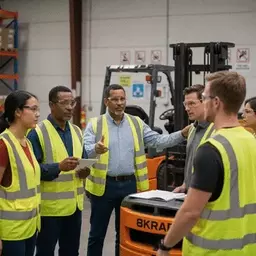
Communication is part of machinery safety. Use radios, agreed hand signals, clear exclusion signs, and shift briefings. Make sure every operator knows which machine has priority at crossings and which areas are closed due to unstable structures.
● Use forklifts for stable, known, palletised, or salvageable loads.
● Use excavators with the right attachment for structural demolition and heavy sorting.
● Use loaders or skid steers for short-distance debris handling and clean-up.
● Use cranes or engineered lifts only when loads, lift points, and ground bearing are confirmed.
Check Licences, SWMS, And Competency
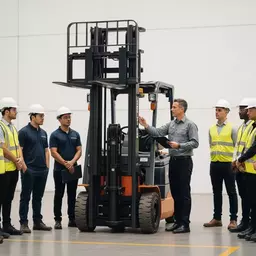
Machinery choice is only safe when operators are competent. Forklift work needs the right licence class. High-risk demolition tasks need safe work method statements, site inductions, supervision, and task briefings.
Do not assume a skilled warehouse operator is ready for a demolition environment. The operator must understand unstable loads, restricted visibility, dust, uneven surfaces, changing routes, spotter communication, and emergency stop procedures.
Site managers should keep licence records, plant inspection records, maintenance checks, attachment approvals, and pre-start forms together. These documents support compliance and make it easier to remove unsafe equipment from service.
Check Ground Bearing Before Any Lift
Demolition changes the ground under the plant. Slabs may be cut, weakened, undercut, or loaded with debris. Drain covers, pits, service trenches, and old repair patches can fail under wheel loads that seemed safe during normal warehouse use.
A forklift or telehandler should not travel over unknown slabs with heavy loads. Confirm thickness, voids, trenches, gradients, wet areas, and broken edges. Where information is missing, keep loads lighter, choose another route, or use engineered ground protection.
Ground bearing checks also apply outside the building. Hardstands may hide soft shoulders, cracked asphalt, buried pits, or old fuel infrastructure. A loaded truck, crane, or forklift can create a recovery problem if it sinks or breaks through.
Know When A Telehandler Or Crane Is Safer
Some tasks are better suited to a telehandler, crane, or engineered lift than a standard forklift. Long reach, uneven ground, awkward plant, elevated loading, and outdoor debris zones may exceed what a forklift can handle safely.
Telehandlers can help when the site needs to be reached and rough-terrain capability, but they still need trained operators, load charts, attachment checks, and stable ground. A telehandler is not a shortcut around lift planning.
Cranes are useful for known heavy lifts, plant removal, roof equipment, and items with engineered lift points. They require lift studies, exclusion zones, communication, and weather checks. Use them when controlled lifting is safer than improvising with a smaller plant.
Run A Machinery Pre-Start That Fits Demolition Work
A normal pre-start is not enough when the work area changes every shift. Operators should check the machine and the environment. That includes tyres, forks, hydraulics, lights, alarms, mirrors, seatbelts, attachments, fluid leaks, and controls.
The site check should include new floor openings, debris piles, wet patches, unstable walls, temporary props, overhead hazards, changed exclusion zones, and pedestrian routes. Yesterday's safe path may not be safe after a wall or slab is removed.
Supervisors should record who completed the pre-start and what changed. A short written note helps the next operator understand why a route was closed, why an attachment was removed, or why a load limit changed.
If a defect affects steering, braking, lifting, visibility, stability, or warning devices, the plant should be tagged out. Demolition sites leave little margin for operating equipment with known faults.
Conclusion
Heavy equipment on industrial demolition sites should be selected by task, ground condition, load type, and stage of work. Forklifts are useful for controlled material handling, but structural demolition needs specialist plant and attachments.
For Xtreme Forklifts readers, the strongest safety habit is to treat a demolition site as a changing workplace. Recheck the surface, load, route, and exclusion zone before every lift or movement.
Quick Pre-Start Checklist
Before the first contractor arrives, the project owner should turn the article's advice into a short site checklist. The checklist does not need to be complex, but it should name the person responsible for each decision so nothing sits between trades.
Review the checklist during the site induction and again when the work changes stage. Demolition, clearing, machinery movement, waste handling, and pest control all create new risks as conditions change.
Keep one named site contact responsible for updates, because small discoveries can quickly affect access, timing, neighbours, waste handling, equipment choice, and final handover. Record every change before the next crew starts work.
● Confirm the exact work scope, exclusions, and required handover condition.
● Check permits, service isolation, access limits, neighbour impacts, and public protection.
● Mark retained structures, trees, services, drains, fences, and no-go zones before work started.
● Separate waste streams early and keep disposal, recycling, and treatment records together.
● Photograph key conditions before, during, and after work so decisions are traceable.
Frequently Asked Questions
Can forklifts be used on demolition sites?
Yes, forklifts can be used for controlled material handling on stable surfaces. They should not be used for structural breaking, pulling, dragging, or lifting unknown loads.
What equipment is used in industrial demolition?
Industrial demolition may use excavators, loaders, skid steers, forklifts, telehandlers, cranes, trucks, breakers, grabs, shears, magnets, and pulverisers, depending on the site.
What should operators check before using machinery on a demolition site?
Operators should check surface conditions, exclusion zones, load weight, visibility, overhead hazards, attachment rating, route changes, and communication with spotters.
Works Cited
Environment Protection Authority Victoria. "Escaped Waste Can Cost Builders." EPA Victoria, 21 Apr. 2026, https://www.epa.vic.gov.au/about-epa/news-media-and-updates/news-and-updates/escaped-waste-can-cost-builders.
WorkSafe Victoria. "Demolition." WorkSafe Victoria, reviewed 2026, https://www.worksafe.vic.gov.au/demolition.
WorkSafe Victoria. "Construction." WorkSafe Victoria, reviewed 28 Sept. 2025, https://www.worksafe.vic.gov.au/construction.
Department of Energy, Environment and Climate Action Victoria. "Guidelines for the Removal, Destruction or Lopping of Native Vegetation." Victorian Government, 2026, https://www.environment.vic.gov.au/native-vegetation.
Sustainability Victoria. "Circular Economy Opportunities for Victoria." Sustainability Victoria, 2025, https://www.sustainability.vic.gov.au/